Birdwatching with kids at the Goolwa Barrage and Murray Mouth, without paying for a tour
Last checked: 19 Nov 2026 (Adelaide time). Rules, fees and fire restrictions change — use the official links on this page before you book or go.
Disclosure: This site may earn a small commission in future if you buy through some links. Right now there are no affiliate links on this page, and nobody pays to be mentioned.
This is a research-led suggested plan, not a trip report. I’m a Brighton dad with an 8- and a 6-year-old, and we haven’t done this trip for this guide. Every hour, rule and facility below comes from official or operator pages, checked on 19 Nov 2026 (Adelaide time). We can’t promise you’ll see any particular animal. Some days the birds and seals just aren’t there.
The short answer
- You don’t need a tour or a boat to see Coorong birdlife with kids. The Goolwa Barrage has a walkway across the barrage and over the lock gates, and it’s free. The SA Tourism listing says entry is free, mentions plenty of birdlife and says you can often spot seals. It also lists a sheltered barbecue area, shade trees, lawn and public toilets close by (South Australian Tourism Commission; SA Water).
- Go in the listed visiting hours. The SA Tourism listing gives 8:30am–12:30pm and 1:30pm–4:30pm daily. SA Water’s lock page lists Goolwa Barrage lock operating times of 8am to 12.30 (printed as “12.30am”, which looks like a typo for 12:30pm) and 1:30pm–4:30pm, labelled ACST. The two don’t quite agree, and neither is a dedicated SA Water visitor-hours page. Call the Goolwa Visitor Centre on 1300 466 592 to confirm before a long drive (SA Water lockages).
- Add the Murray Mouth. Alexandrina’s visitor services say it’s about 15 km by road from Goolwa over the Hindmarsh Island Bridge, and there is a viewing area with interpretive signs. Their bird-trail brochure lists godwits, Pacific golden plovers and other migratory waders there from September to April (Hindmarsh Island brochure; Alexandrina bird trails brochure). Both brochures are older council publications (2013 and 2015), so check the signs on the day.
- Coorong National Park is November’s NPWS Park of the Month. Its free events include a Goolwa Barrage talk on Thursday 26 November, 10–11am, run by DEW, SA Water and Ngarrindjeri representatives. NPWS says it’s for all ages. Registration was open when we checked (NPWS Park of the Month; Humanitix event page).
- H5 bird flu is in South Australian wildlife. The SA Government says the public risk is low and you don’t need to avoid parks or beaches simply because birds are there. Teach the kids one firm rule: never touch a sick or dead bird or animal (birdflu.sa.gov.au).
Who it suits, and who it doesn’t
Suits:
- Families who want a nature outing for the cost of fuel and a packed lunch. Every stop in the main plan is free to visit.
- A day test. You can find out whether your kids like watching birds before you book a night away or a paid wildlife tour.
- Kids who like machines as well as animals. The barrage is a working water structure, and boats sometimes go through the lock.
- Couples, solo travellers and grandparents. It’s the same plan at a slower pace.
Doesn’t suit (or needs a different plan):
- Anyone hoping for guaranteed close-up animals. This is about watching from a respectful distance. Some visits will be mostly pelicans, gulls and cormorants, and some will be quiet.
- Very hot, very windy or Total Fire Ban days. The barrage walkway and Murray Mouth area are exposed. NPWS cancels its 26 November barrage talk if a Total Fire Ban is declared for the Mount Lofty Ranges district, and says Coorong National Park is closed on Catastrophic fire danger days.
- Dogs. See “Access and facilities”. The national park dog rules are strict around the Murray Mouth.
- Families who want 4WD or ocean fishing. Neither is part of this beginner plan. NPWS warns that Coorong ocean beach driving is currently risky because of erosion and dune collapses (NPWS Coorong National Park).
What a 6-year-old can manage
- The barrage walk. NPWS describes the path from the car park as flat and wide. It says the barrage is wheelchair accessible except for one small lookout reached by stairs (NPWS barrage talk page). A walk out and back is a comfortable outing for most 6-year-olds. Hold hands near the lock and the water.
- Attention span. Plan short stops of 20–40 minutes, with snacks in between, rather than one long session. That’s our suggestion, not an official figure.
- The Murray Mouth lookout. Alexandrina describes a viewing area with interpretive signs. We haven’t confirmed how far it is from the parking or what the path is like, so let the 6-year-old set the pace. Turn back if it’s sandy and hot.
- The drive. Allow for the drive home after a morning in the sun and wind. A 6-year-old may be done by early afternoon.
Suggested plan: a day test, with an optional Goolwa night
Morning: Goolwa Barrage
- Check conditions before you leave (see the checklist below): forecast, wind, fire danger and any bird flu notices.
- Arrive after the barrage opens. From the Goolwa Visitor Centre, Alexandrina’s bird brochure says the barrage car park is about 4.5 km away via Oliver Street and Barrage Road. The NPWS event address is 344B Barrage Road, Goolwa South.
- Walk out slowly and stop often. The lock is about 30 metres long, and SA Water’s viewing platform looks straight down the Coorong side. SA Water says the site is “frequently visited by an array of amazing wildlife and aquatic birds”.
- Play the observation game (below) at the halfway point, then walk back for the toilets and a snack in the shade.
- Optional extra: Alexandrina’s brochure says a road behind the barrage buildings runs about 2.3 km along the saltwater side to No. 19 Beacon. It lists migratory waders there at low tide in season. Watch from the road edge or the car rather than walking out onto the flats.
Middle of the day: lunch and a break
Have a picnic at the barrage (the SA Tourism listing mentions a sheltered barbecue area and lawn), or head into Goolwa. If the kids are flagging, stop here and drive home. You’ve had a full day test.
Afternoon (optional): Hindmarsh Island and the Murray Mouth
- Cross the Hindmarsh Island Bridge. Alexandrina’s brochure says to follow Randell Road for about 7 km, turn right into Semaschko Road and follow the Murray Mouth signs.
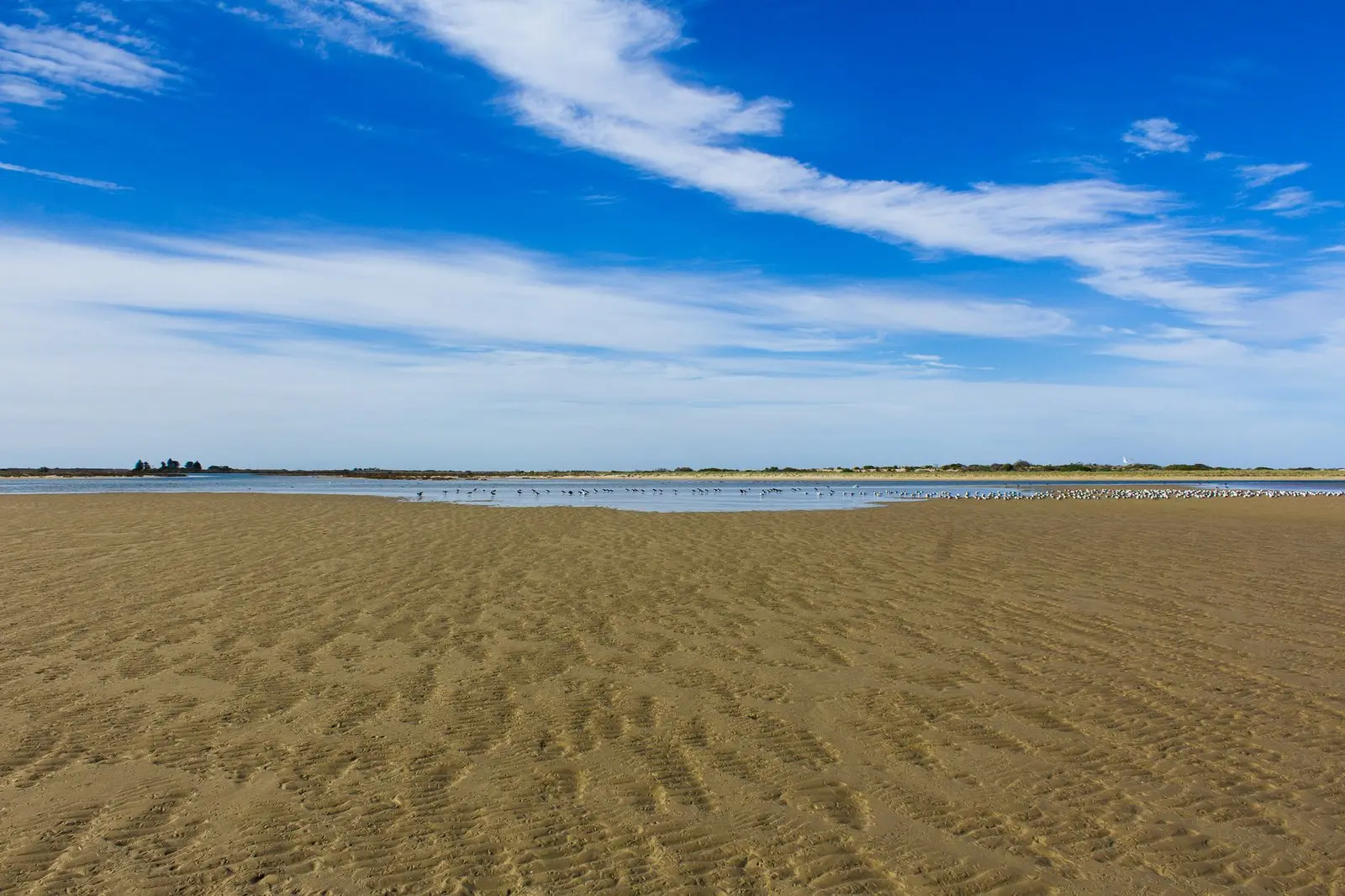
- Murray Mouth lookout: look across to the mouth, the sandbars and the Younghusband Peninsula. Alexandrina’s bird brochure lists gulls, terns, oystercatchers, cormorants and migratory waders in season.
- Toilets: NPWS’s November art event page says public toilets are near the boat ramp on Mundoo Channel Drive, and that the café toilet at Sugars Beach is for customers only (NPWS Art in the Park page).
- Leave the birds where they are. On the sand, walk at the water’s edge or on marked paths. Turn back well before you reach any group of resting birds (see “The respectful-distance lesson”).
Want to make it two sleeps?
Use Goolwa as a base and split the plan: barrage on the first afternoon, Murray Mouth the next morning, then a third activity. Our Cockle Train and Granite Island guide covers the heritage train from Goolwa Station and the Victor Harbor side, so we won’t repeat it here. A bird morning and a train day make a good pair over a weekend. For accommodation, Goolwa has caravan parks, including Discovery Parks – Goolwa. We haven’t checked prices or availability for this guide, so check with the park.
The observation game (for 6- and 8-year-olds)
Pick one card per stop. Write or draw the answers on paper, or take a phone photo from where you’re standing. No zooming in by walking closer.
- Count and compare: “How many pelicans can you count? Are more of them on the water or flying?”
- Fresh or salty? The barrage separates the fresh river from the salty estuary. “Which side has more birds today? Why might that be?”
- Who’s fishing? “Can you spot a bird diving, dipping its beak or standing very still?”
- Seal or log? “Is that dark shape moving? Wait one minute and check again.”
- Quiet challenge: “Stand still for 30 seconds and listen. How many different bird sounds can you hear?”
A free bird ID app or a printed sheet of common waterbirds helps older kids put names to what they see. NPWS’s Park of the Month page also links a free “Coorong Nature Hunt” bingo sheet from Friends of the Coorong (an older, 2015 sheet; it opened when we checked on 19 Nov). It includes squares like “feather” and “bird nest”. Treat those as spot-and-tick only: the SA Government’s bird flu advice is to avoid contact with bird droppings and feathers.
The respectful-distance lesson
Teach this one simple rule: if an animal changes what it’s doing because of us, we’re too close. Then step back.
- Seals: DEW says not to get closer than 30 m to a seal on land, and never to get between a seal on shore and the water. Don’t feed seals or any marine mammal (DEW seal FAQs). If a seal is resting near the walkway, don’t stop beside it. Keep walking and watch from further along.
- Shorebirds: migratory shorebirds have flown huge distances and need to feed and rest. BirdLife Australia asks birdwatchers to keep an appropriate distance, stay on formed paths and not play bird calls from phones (BirdLife Australia ethical birdwatching guidelines).
- Hooded plovers and beach-nesting birds: the Hills and Fleurieu Landscape Board says hooded plovers breed between August and March. It asks beachgoers to stay below the high tide mark, give signed or fenced areas plenty of space and quietly move away if they spot one (Landscape SA Hills and Fleurieu). BirdLife says to leave lone chicks alone, because the parents are usually nearby.
- Pelicans: DEW says the Coorong pelican population varies between about 2,000 and 4,000 birds, depending on inland water conditions. Watch them; don’t feed them.
Costs and booking
| Item | Cost | Booking |
|---|---|---|
| Goolwa Barrage | Free entry (SA Tourism listing) | None |
| Coorong National Park | No vehicle entry fee. Camping fees apply (NPWS) | Only for camping |
| Murray Mouth lookout and Hindmarsh Island stops | We found no entry fee | None |
| NPWS Goolwa Barrage talk, Thu 26 Nov 2026, 10–11am | Free | Register on Humanitix (open on 19 Nov) |
| NPWS Art in the Park, Sat 28 Nov 2026, 10:30am–12:30pm, Sugars Beach | Free, materials provided | Register on Humanitix (open on 19 Nov) |
| A night in Goolwa | Not checked | Check with the accommodation |
About the November events. The 26 November barrage talk is on a school-day morning, so it mainly suits preschoolers, home-schoolers and grandparents. The 28 November botanical drawing workshop is on a Saturday. NPWS says it’s suitable for beginners, but doesn’t give an age range and says it’s not wheelchair accessible. If you’re thinking of bringing kids, ask NPWS first (dew.parkofthemonth@sa.gov.au). The “Science on the Shore” day at Parnka Point on 25 November showed as sold out, and it’s much further down the Coorong anyway.
Paid cruises also run from Goolwa into the Coorong. This guide is about the free version, so we haven’t compared them.
Access and facilities
- Getting there: Goolwa is on the Fleurieu Peninsula. NPWS notes that from Goolwa you can reach only the very top end of the Coorong, because there is no vehicle access across the barrages or the Murray Mouth into the main part of the park.
- Barrage path and toilets: NPWS says the path from the main car park is flat and wide, with accessible toilets at the start. The SA Tourism listing mentions a sheltered barbecue area, shade trees and lawn.
- No public access to the other barrages. Alexandrina’s Hindmarsh Island brochure says there’s no public access to the barrages from Hindmarsh Island, and NPWS says there’s no public access to the Tauwitchere barrage at Pelican Point.
- Goolwa Visitor Centre: 4 Goolwa Terrace, Goolwa. Open 10am–4pm, 7 days, closed Good Friday, Christmas Day and Boxing Day (Visit Alexandrina).
- Phone reception: NPWS says mobile coverage in Coorong National Park can be patchy, especially in low-lying areas. Download maps before you go.
- Dogs: NPWS says dogs are allowed in Coorong National Park only below the high water mark on the Ocean Beach, on a lead no longer than 2 m. They must be taken to and from the beach directly, inside a vehicle. Dogs are not permitted in the waters of the Coorong Lagoon, including the area between the Murray Mouth and the Goolwa Lock. Parts of Hindmarsh Island near the Murray Mouth are inside the national park. If your dog is coming, check NPWS and Alexandrina Council signs at each stop. Some families will find it easier to leave the dog at home for this one. The SA Government’s bird flu advice also asks dog owners to keep dogs on a lead in wildlife areas and away from sick or dead birds (DEW bird flu FAQs).
- Vehicles on the sand: SA Water says parts of Sir Richard Peninsula (Goolwa Beach) and the Murray Mouth are off limits to vehicles and motorbikes, with signs and barriers. The beach drive to the Murray Mouth from Goolwa Beach is 4WD territory and isn’t part of this plan (SA Water; Alexandrina Council Goolwa Beach).
- Country: NPWS says the Coorong is of enormous cultural significance to the Ngarrindjeri people. It asks visitors not to touch or remove anything, and to take all rubbish home.
What to bring
Genuinely needed:
- Water for everyone, plus a spare bottle
- Hats, sunscreen and layers. Both sites are exposed to sun and wind
- Enclosed shoes. NPWS lists these for its barrage talk
- Snacks or a packed lunch, and a rubbish bag (NPWS asks you to take rubbish home)
- Hand sanitiser or wipes. The SA Government advises washing hands after time in wildlife areas
- A phone, for photos from a distance and to check fire and weather updates
Optional comforts:
- A picnic rug, and insect repellent (NPWS lists it as optional)
- A notebook and pencils for the observation game, or a printed bird sheet
Use what you own: a phone camera is enough. Walking closer for a better photo is exactly what we’re trying not to do. Watch with your eyes, and use the phone to remember.
Safety and current-condition checks
- Fire danger. Goolwa and Hindmarsh Island are in Alexandrina Council. The CFS lists Alexandrina in the Mount Lofty Ranges fire ban district. Its Fire Danger Season runs 1 December 2026 to 30 April 2027 (CFS district list; CFS season dates; our fire season guide). NPWS says Coorong National Park is closed on Catastrophic fire danger days and may close on Extreme days. Check the CFS ratings on the morning.
- Our own family rule: we cancel if the fire danger rating is Extreme or Catastrophic, or if it’s over 40°C with strong winds. Extreme is our hard stop.
- Weather and wind: check the Bureau of Meteorology Goolwa forecast. On hot days, the 8:30am opening slot is the better choice.
- Bird flu: avoid, record, report. The SA Government says H5 bird flu has been in SA wildlife since June 2026. Its 19 November update lists 344 confirmed events in the state. The risk to the public remains low, and there have been no detections in poultry or livestock. Walking past a sick or dead bird without touching it doesn’t put people at risk. Don’t touch, move or collect sick or dead birds or mammals, and keep children and pets away. The wildlife advice also says to avoid contact with bird droppings, feathers or contaminated water, so no feather souvenirs this time. If it’s safe, note the location and take a photo from a distance, then call the Emergency Animal Disease Hotline on 1800 675 888 (birdflu.sa.gov.au, 19 Nov update, wildlife advice, human health). ABC News reported in August 2026 that a dead dolphin found at Goolwa had tested positive (ABC News, 28 Aug 2026). Check the government’s interactive map before you go.
- Water contact: this plan doesn’t include swimming or paddling. If anyone gets wet at the beach, the SA Government’s algal bloom site says most of the coast has recorded zero or low Karenia levels since February 2026. It advises staying out of foamy or unusually coloured water and keeping pets away from sick or dead fish (Algal Bloom Update).
- Near the lock and the water: keep young kids within arm’s reach, and follow SA Water’s signs and fences.
- Park alerts: check the NPWS Coorong page for alerts before you go. On 19 Nov 2026 the alert was about Ocean Beach erosion, which doesn’t affect this plan.
Fallback plans
- Barrage closed or outside its hours: start at the Murray Mouth lookout instead, and call the Goolwa Visitor Centre (1300 466 592) to check when the barrage reopens.
- Too hot or windy: do one short barrage visit at opening time and go home, or put it off. The birds will still be there in autumn.
- Fire danger Extreme or Catastrophic: postpone.
- Closer to Adelaide: Laratinga Wetlands at Mount Barker has short marked loops and is free. It’s covered briefly in our strawberry picking guide.
- Want trains too: pair this with the Cockle Train and Granite Island plan.
Sources (checked 19 Nov 2026, Adelaide time)
- National Parks and Wildlife Service SA: Coorong National Park (alerts, fees, dogs, access, facilities, fire), Park of the Month: November, Coorong National Park
- NPWS event pages on Humanitix: Goolwa Barrage talk, 26 Nov, Art in the Park, Sugars Beach, 28 Nov, Science on the Shore, Parnka Point, 25 Nov (sold out)
- SA Water: Improved public access at Goolwa Barrage (18 Jun 2020), Lockages (Goolwa lock hours), Driving restrictions on Goolwa sand dunes
- South Australian Tourism Commission: Goolwa Barrage listing (hours, free entry, facilities)
- Alexandrina Council / Visit Alexandrina: Visitor centre hours, Hindmarsh Island, Hindmarsh Island brochure, Bird trails brochure, Goolwa Beach car park and environs
- Department for Environment and Water: Seal FAQs (30 m rule, pelican numbers), Bird flu in SA FAQs
- SA Government bird flu site: Home, 19 Nov 2026 update, Wildlife, Human health
- BirdLife Australia: Ethical birdwatching guidelines, Sharing our shores
- Landscape SA Hills and Fleurieu: Protecting hooded plovers
- CFS: Fire Danger Season dates, Mount Lofty Ranges district areas, Total Fire Bans and ratings
- SA Government: Algal Bloom Update
- Bureau of Meteorology: Goolwa forecast
- ABC News: H5N1 detected in a dolphin at Goolwa (28 Aug 2026)
- Discovery Parks: Goolwa